
{{ e.index }}
{{ e.title }}
{{ e.body }}
Standard platforms are built around average dimensions and straight-line assumptions, which works fine until the object being serviced has curves, tapers, or an irregular footprint a generic design was never meant to accommodate.
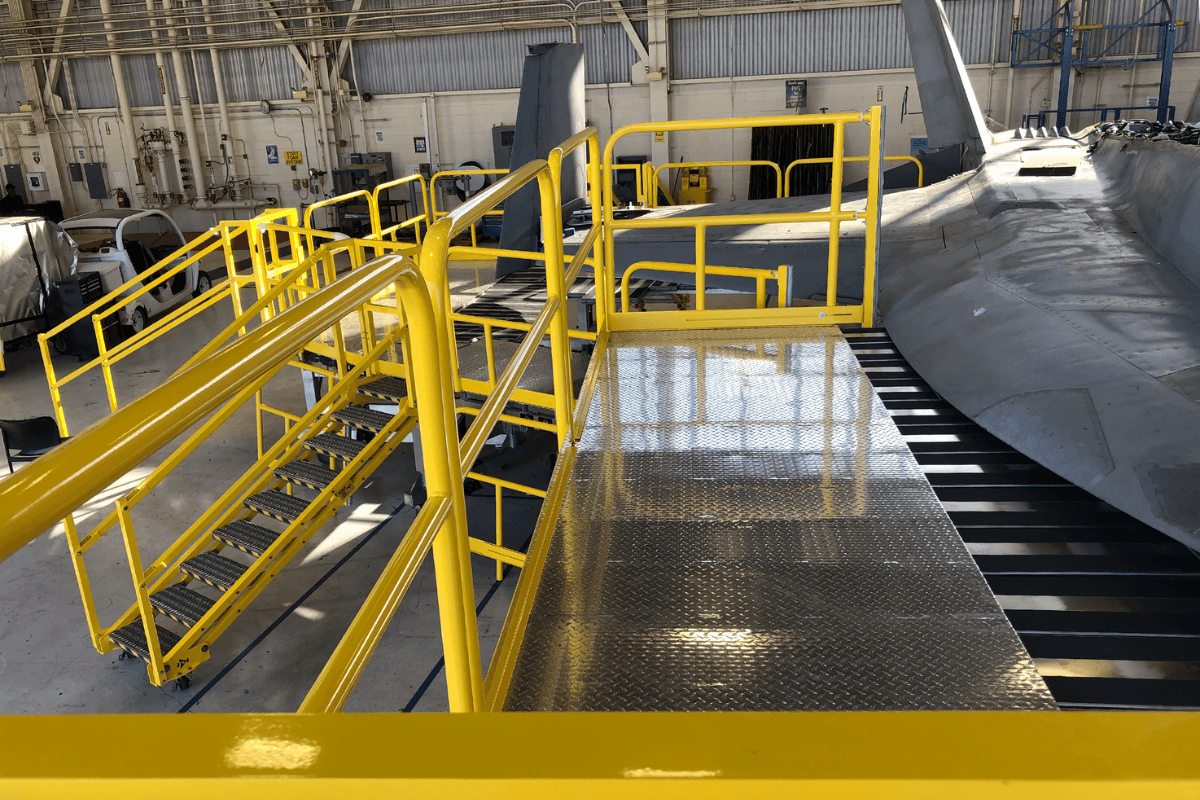
An access platform that doesn't contour to an airframe risks "hangar rash," physical contact damage to high-value aircraft surfaces during routine maintenance.
A maintenance platform that doesn't account for a vessel's hull curvature risks damaging gelcoat and painted finishes that are expensive and time-consuming to repair.
In both cases, the equipment itself becomes the source of damage it was supposed to prevent.
JE's engineering team develops platforms and fixtures around the exact geometry of the asset being serviced, contouring perfectly to the specific airframe, hull, or equipment shape, so technicians get precise, ergonomic access without the platform itself touching or damaging the surface.
{{ s.body }}
This "zero-contact" engineering principle applies the same underlying discipline whether the asset is a rotorcraft, a business jet, a wide-body transport, or a marine vessel.
Wherever a high-value asset's surface can be damaged by imprecise equipment, and wherever complex geometry would otherwise force technicians into awkward, inefficient working positions.
{{ e.body }}
JE's contour-fit engineering has been proven across two genuinely different geometric challenges — aircraft airframes and marine vessel hulls — under two dedicated product lines built specifically around this problem.
{{ a.body }}
Every route below applies the same zero-contact, contour-fit engineering principle described on this page — built around the specific shape of the asset being serviced, not a generic configuration.

JE's zero-contact engineering discipline is proven through two dedicated, named product lines — each solving the same underlying geometry problem for a different high-value asset.
{{ q.answer }}