
{{ m.index }} · Material
{{ m.title }}
{{ m.body }}
OSHA's walking-working surfaces standard (29 CFR 1910, Subpart D) covers far more than fall protection alone — it governs floors, stairways, ladders, platforms, ramps, and equipment access points, each with specific requirements for load capacity, surface traction, and structural performance.
A product that's compliant "on paper" isn't necessarily compliant in practice unless it's actually been tested against these requirements.
A compliant platform must support its maximum intended load, minimize slip hazards, and meet specific requirements depending on whether it's accessed by stairs or a ladder. This is a wide, detailed standard.
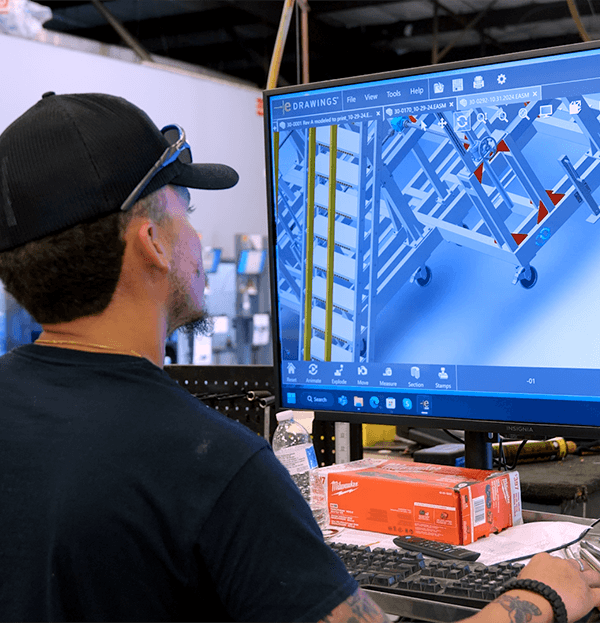
JE's platforms, stands, and ladders undergo Finite Element Analysis and proof load testing as part of the standard design process — not an optional add-on.
{{ g.body }}
The rating isn't an estimate — it's the result of structural analysis and physical proof load testing performed on the actual design.
OSHA compliance doesn't look the same in every environment — a ladder built for outdoor industrial use has different material requirements than one built for a cleanroom, which is why JE offers OSHA-compliant equipment in materials matched to where it will actually be used.
{{ m.body }}
JE backs its OSHA compliance claims with actual engineering verification — structural analysis, proof load testing, and documented load ratings — rather than relying on a compliant-looking design that hasn't been physically validated.
{{ a.body }}
Every route below leads to equipment that has been through the same verification process described on this page — Finite Element Analysis and proof load testing, not just a compliant-looking design.

JE publishes practical engineering guidance on OSHA and ANSI compliance — not just product specs — because understanding the standard is the first step to specifying the right equipment, and that's a conversation JE's engineering team is equipped to have before a quote is ever requested.
{{ q.answer }}